
Show how you will cover supports
Use weekly allocations and worker rosters to review planned coverage before committing to a participant’s schedule or a contract’s service requirements.

For Australian NDIS providers
Global Care HQ
Plan reliable support, record the visits you deliver and bring your operational evidence together when discussing new service agreements or applying for contracts.
See visits across the week and allocate a worker to each one. A practical view of your capacity helps you discuss what your team can deliver before agreeing to new supports.
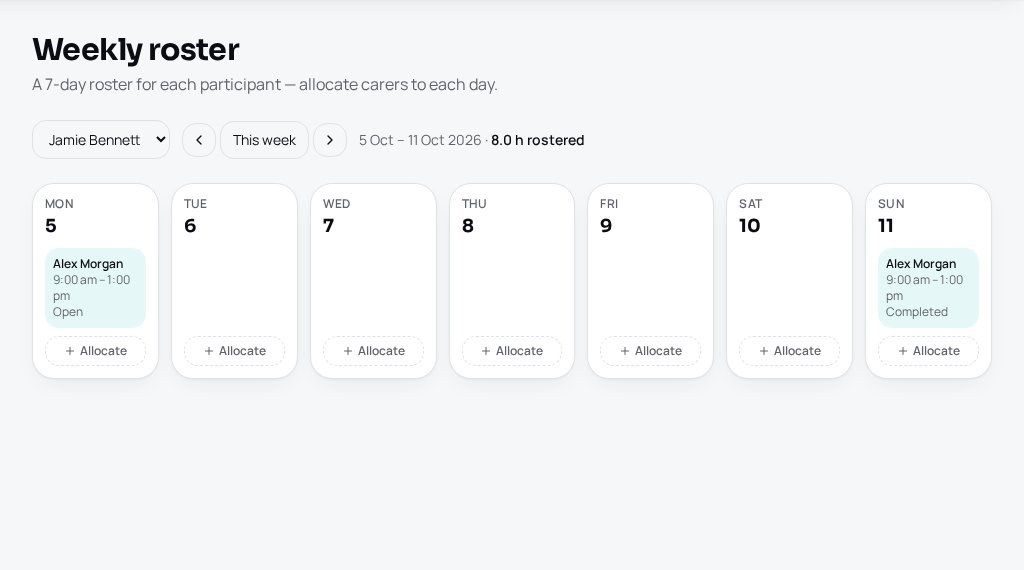
Actual Global Care HQ screen with illustrative example details.
Contract readiness
Winning work depends on your service quality, capacity, suitability and the buyer’s requirements. Global Care HQ helps organise evidence of your operations; it does not secure contracts, grant NDIS registration or guarantee compliance.
Use weekly allocations and worker rosters to review planned coverage before committing to a participant’s schedule or a contract’s service requirements.
Recorded visit times, GPS attendance and care notes help you reconcile planned support with delivered visits and prepare accurate invoices. Review records before making claims.
Worker checklists, document expiry tracking, policy approvals and training completion records help managers review readiness. Software records do not replace professional checks or required qualifications.
An NDIS service agreement sets out the supports and costs agreed between a participant and provider. A tender or procurement contract has its own selection criteria. Match your proposal and evidence to the actual requirements rather than treating software as a substitute for them.
Official guidance
NDIS: What is a service agreement? — recommended for participants; written agreements are required for SDA.
NDIS: Record-keeping requirements — keep complete, accurate evidence of supports delivered.
NDIS Commission: Governance and operational management — applicable Practice Standards include systems for regulatory and contractual responsibilities.
Illustrative workflows — not client case studies
A coordinator reviews a proposed weekly schedule, checks worker availability, then allocates visits. The provider discusses the supports and costs with the participant and records the agreed schedule. This is an example workflow, not a reported client outcome.
A manager checks completed visits against the plan and reviews workforce documents, training and policy approvals. They use relevant records to prepare their response to the buyer’s criteria. No contract win or performance improvement is claimed.
See all participants alphabetically across the week and allocate a carer to each visit in a couple of taps.
Send open shifts to suitable workers and let them accept from their phone, so gaps get filled fast.
Workers sign on and off at the visit with one big button. Location and times are recorded for every shift.
Hours are split by time of day, weekends and public holidays so payroll preparation matches the SCHADS award.
Every worker and contractor sees their own week, and can request changes without phone tag.
Completed visits flow into NDIS invoices and contractor invoices, so you bill what was actually delivered.
Rostering comes with compliance, training, incidents, payroll preparation and invoicing in every plan.
See plans and pricing →